Dell Inspiron 1525 Laptop and Linux
Ted Felix

Introduction

Open Source has come a long way. January of 2009, I decided to get my daughter a laptop for her summer writing workshop and I wanted to go with Ubuntu if possible. Here's what I found. Note that all of this info applies to a January 2009 vintage Inspiron 1525, and that things might change substantially in the future.

Buying

Buying from Dell is a little tricky. You can get an Ubuntu laptop straight from Dell, but it costs more than the equivalent Microsoft Windows Vista laptop, and you don't have Vista to fall back on. Then, if you do shop for a Vista laptop, depending on how you go through Dell's website, the price can be wildly different. It pays to try configuring your system through different paths to see if you can get a better price. It also pays to search for Dell coupon codes ("e-value" codes). I found one that saved me an extra $150, and brought the price down to $706 including some minor upgrades and two carrying bags. Of course, shipping and tax brought the total up to nearly $775. Ouch.

If you plan on running Linux, make sure you get all Intel hardware. I switched out the Dell wifi card (probably Broadcom which isn't well supported by Linux) for the Intel wifi card. The Inspiron 1525 also comes with Intel's video interface which works perfectly with Linux. With all Intel hardware, Linux has no trouble at all.

Finally, the i1525 touchpad is awful. I've used other touchpads that worked fine. This one is garbage. To be safe, I recommend adding a mouse to your order. There are forum postings that show how to make the touchpad work a little better by changing settings for the synaptics driver ("man synaptics" for more). However, it's still useless after this. It seems to lose the fact that it is being touched at random times. Maybe in a few years Dell will offer a replacement part that will fix the problem, but for now, forget about it. There are many posts on the Internet detailing this issue both in Windows and Linux, so it is a known hardware issue.


Installing Operating Systems

When it arrived, the hard drive was chock full of garbage, as usual. In addition to the Vista partition, there was a recovery partition and an incredibly buggy and useless Dell MediaDirect partition. After fiddling a bit with these partitions, I finally decided that the best policy would be to remove them all and start from scratch. I started by installing a 40gb Vista partition (Just in case Ubuntu doesn't work out. So far, Ubuntu has been great.), then a 10gb backup Ubuntu 8.10 partition, and finally the main Ubuntu 8.10 partition. Installing in this order avoided all sorts of configuration problems, and the system came up without a hitch.

Laptops and Hard Drives

The first order of business, once Ubuntu was up, was to figure out how to stop the hard drive from loading and unloading all the time. Laptop hard drives constantly load and unload in case the computer is jarred to prevent damage to the hard drive. However, with Linux, hard drives load and unload so frequently (unless you enable laptop mode) that they wear out very quickly.

Ubuntu 9.04 Update

When I first loaded 9.04, it appeared that the hard drive APM was off even without me adding an hdparm line to the rc.local. However, after a few months I noticed that the Load_Cycle_Count was indeed increasing. So I followed the 8.10 instructions below and all is well now. I recommend getting familiar with the output of "smartctl -A" and noting if any values like "Load_Cycle_Count" are increasing and the drive is making any funny clicking noises when it is not in use. If so, some investigation is in order.

Ubuntu 8.10

Fixing this turned out to be straightforward. The drive responded correctly to the following command which effectively disables APM:

hdparm -B 254 /dev/sda

The trick was to get this to happen both at boot, and after a suspend or hibernate. Adding it to /etc/rc.local did the trick for boot time, and the following script called /etc/pm/sleep.d/hdparm.sh handles suspend and hibernate (see "man pm-suspend" for more):

#!/bin/sh
# Make sure hard drive APM is off upon thaw and resume.
# See also /etc/rc.local

case "$1" in
	hibernate|suspend)
		exit $NA
		;;
	thaw|resume) 
		hdparm -B 254 /dev/sda
		;;
	*) exit $NA
		;;
esac

Note: There is also a /etc/hdparm.conf file where you can put this APM setting. I've not tried this, but it might be simpler if it works. Be sure to test rebooting and suspending if you go this way. I've read that hdparm.conf has no effect on resume, so proceed carefully.

Firewall

Before connecting directly to the Internet, it is a good idea to make sure your system is properly firewalled. I've been using easyfwgen which works well. Ubuntu offers ufw which makes enabling the firewall very easy. For the most part, a default Ubuntu install is pretty safe without a firewall, but if you want the added peace of mind, try ufw (or easyfwgen), then test your system with nmap from another computer on a private LAN. Note that nmap will indicate "filtered" for your ports if everything is locked down. Also try Gibson Research (www.grc.com) which has a port scanning test (called "ShieldsUP!") once you are online.

/tmp Cleanup Interval

Ubuntu cleans up /tmp every time you boot. This can be annoying if you like to use /tmp for working on things temporarily. In /etc/default/rcS there is a "TMPTIME" variable which sets the number of days old a file must be before it is deleted from /tmp. I set this to 15.

Playing mp3's and DVD's

Since there are legal issues surrounding decoding DVDs, Ubuntu does not come with support for DVD playback. You have to either install it on your own, or you can also buy it if you want to be technically legal.

The Legal Way

Canonical sells the Fluendo Complete Playback Pack for about US$40. Buy it and install it, and all should be well. It is notable, however, that this doesn't appear to provide an mp3 encoder. You'll have to grab either LAME (see "Ripping CD's to mp3" below) or the Fraunhofer encoder. The Fraunhofer encoder is free for personal use and 100% legal. LAME is iffy, but since Fraunhofer is free, shouldn't LAME also be?

The Illegal Way 10.04

For 10.04, and maybe 9.10, totem-xine is no longer supported. So you've got to do DVDs with gstreamer. Here's what I did:

sudo aptitude update
sudo aptitude install ubuntu-restricted-extras
sudo /usr/share/doc/libdvdread4/install-css.sh
(reboot) [might be unnecessary]

The Illegal Way 9.04

Here's how I did it for Ubuntu 9.04:

sudo aptitude update
sudo aptitude install ubuntu-restricted-extras
sudo /usr/share/doc/libdvdread4/install-css.sh
sudo aptitude install totem-xine
sudo update-alternatives --config totem
(select "xine" which is #2)
(reboot)

Using this method we've been able to play DVDs from region 1 and region 2. I think this essentially gives you a region-free DVD player.

The Illegal Way 8.10

This worked in Ubuntu 8.10.

Install all the gstreamer stuff and "ubuntu restricted extras" (I had to use synaptic since it had to uninstall something). Then do this:

sudo aptitude install totem-xine libxine1-ffmpeg libdvdread3
sudo /usr/share/doc/libdvdread3/install-css.sh
sudo update-alternatives --config totem

And switch to xine. Next, reboot the machine, and Totem should be able to play DVD's.

That can probably be done cleaner, but I didn't realize I needed to reboot for changes to take effect. So I struggled a bit since it wasn't working. Try doing some of the above then rebooting. It might work better for you.

The above should have also set RhythmBox up to play mp3's. Be sure to test that before continuing.

Note that Totem has its own volume control in addition to the Master and PCM volume controls. Be sure to check them all if the volume seems low.

Ripping CD's to mp3

To get mp3 encoding, you'll need to install LAME by doing the following at a command prompt:

sudo aptitude install lame

RhythmBox will then offer an "mp3" option in its settings. It will then rip CDs to 128kbps mp3 files. However, I didn't see an obvious way to just rip selected tracks with RhythmBox. If you need a little more flexibility, install Sound Juicer which will allow you to rip selected tracks.

June 2009: Just noted a problem with ripping CDs with RhythmBox. MP3 files made with RhythmBox are tagged with ID3 V2.4 tags. These newer format tags cannot be understood by the majority of existing mp3 players. The "problem" is in gstreamer's id3v2mux. There's a new id3tag plugin that supposedly allows one to write the old 2.3 tags. Problem is that it is very new, so it isn't in any distros yet. Annoying! It looks like easytags is a good solution. It can be configured to write 2.3 tags. Just bring up the files with 2.4 tags and resave them with easytags.

Reading Free ebooks

You can set up Firefox to be a reasonable ebook reader by setting the preferences so that it reloads on start the pages it had opened when it was closed. It even remembers where you were. However, my daughter prefers using EText Reader for reading ebooks. This can be run in Ubuntu rather easily. The key is to install libgtk1.2, then install the EText Reader binaries. Unfortunately, libgtk1.2 is no longer available in the Ubuntu repositories. So you have to go back to Jaunty Jackalope's libgtk1.2. It depends on a couple of other packages (libglib1.2ldbl and libgtk1.2-common) that you'll also have to get. Then use "dpkg -i" to install them.

Dead Keys

If you're studying a foreign language and you need accents over your vowels (áéíóú), go to the keyboard layout selection (System | Preferences | Keyboard | Layouts) and switch to the "USA International (AltGr dead keys)" keyboard layout. This allows you to use the "Right-Alt" key to get accents and other special characters. Just hold down the right "Alt" key and press a vowel.

Laptop Schticker

Used schtickers.com to make a sticker to customize the case. Went with a 14" x 10" image at 120dpi and that appears to have printed perfectly with this service. Click on the above image to get the full size version. Used the GIMP and the tux.svg vector graphics image to generate this.


Printer

All of HP's modern printers are supported by the hplip project. Picked up the HP C4480 AIO at Staple's for $70. Scanner and printer work fine. It did take a little while for Linux to notice the new printer was attached, but once it did, all was fine.

Scanning works great. Two important things about GIMP/XSane and scanning... First, you can get to XSane through the GIMP by going to "File | Create | XSane". If your scanner isn't on the list in that menu, then select "Device menu" (I think?). That will let you pick your scanner. Second, some scanners can JPEG compress the data that they send over the USB wire. Obviously this is a very big "no-no" for serious photo scanning. In XSane, go to "Window | Show Advanced options". In there you'll see a compression setting (if your scanner supports this feature). Set it to "None". At first mine was set to JPEG with quality 10 (out of 100!). I was wondering why my scans looked terrible.

There are a lot of other little things you can set up to make life easier when scanning photos (e.g. default dpi and inches vs. centimeters). Be sure to spend some time going through all the menus in XSane to find out what's available.

6/24/2009: Just had a hilarious printer problem. I was getting the infamous "device descriptor read/64, error -71" in /var/log/syslog. After some research and fiddling around with usbcore parameters, I finally figured out it was a loose USB cable. Boy do I feel dumb. So, if the printer isn't working, be sure to pull the power plug, reseat the USB connectors, wait a minute or so, reconnect the power and try again. Pulling the power plug is a good extra step as these printers can get confused by power outages. Trying a different USB cable would also be a good idea in case you've got a bad one.

Additional lessons learned: Make sure you print something at least weekly or the heads dry up. There is no reliable way to bring the heads back to life once this happens. Unless you do a lot of printing, refilling the ink cartridges is a waste of time and money. You've got to refill the cartridges before they go empty (and there's no way to tell when that is) and the ink expires in two years anyway. If you're going through a cartridge a month, you can save big bucks refilling. If, like us, you go through a cartridge every two years, your ink will go bad before you can even use it.

WiFi

8/7/2009: Wireless networking with the Intel wireless card is flawless. When I put the order together, I made sure I selected the Intel card as my understanding was that the stock Dell cards are Broadcom and these can require "ndiswrapper" and the Windows driver (not good). However, it does look like Broadcom is beginning to support Linux, so things might be a lot better now.

There is a physical wireless cut-switch on the right side of the i1525 toward the front. This is explained in the Dell Setup Guide. The easiest way to get up and running is to just turn that switch on (push it toward the back of the laptop) then boot the machine. If you're already booted, turn on the switch, then disable/re-enable wireless by right-clicking on the Network Manager icon next to the clock in the upper right corner of the screen. Then select "Enable Wireless" to uncheck/disable wireless, and select it again to re-enable.
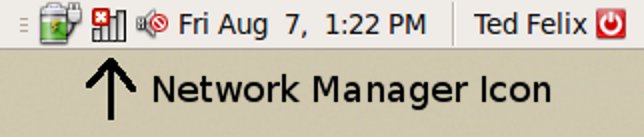
Next you need to pick a wireless network to connect to from the list that can be found when you left-click on the Network Manager icon.

After the connection process completes (the icon will animate to show that it is working), you should be online. Note that the bars in the Network Manager icon become blue when all is well.

For scanning the available wireless networks, kismet is a good tool. It's a little tricky to configure, but the README is helpful.

Webcam

The webcam suddenly started working with cheese in Ubuntu 10.04. Didn't work in 9.04 and prior versions. Didn't really want the webcam, though. It came with the Dell e-value code that I found.

Stuck Key

After a while, the "F" key got "stuck" on the keyboard. It would not press down. You had to press really hard to get it to do anything. I ordered a new keyboard for $15 (including shipping!) on ebay and it was a piece of cake to swap out. Then with the broken keyboard out, I was able to gently pop off the "F" key (using two plastic knives, one on either side, prying gently, with a piece of plastic over top to catch the flying key). The plunger underneath seemed fine, so I carefully replaced the key cap, and the "F" key was fixed. Replacing the key cap is indeed a bit tricky. Examine the bottom of the key carefully. You'll see that there are four places where it snaps into the board. The top two go in first and they are easy. Then you have to gently slide the key up and down to different positions, then press until the bottom two hooks grab the right portion of the mechanism. Study it carefully and it will be obvious. Now I've got a spare keyboard for the next time something happens.

Verdict

So far, so good. A little bit of struggling here and there, but eventually all was well. The only disappointment so far has been the touchpad. The touchpad on my i5150 works great. I use it all the time with no trouble. The touchpads on all the HP laptops at the CostCo work great. The touchpad on this i1525 is a real pain. We bought a cheap wired mouse it was so bad. If we would have known, we would've added a wireless mouse from Dell to the order (or maybe found another model with a working touchpad). In three years, I'll order a replacement touchpad and see if that clears things up. I've heard they are still shipping these defective touchpads, so I'll give it some time to settle.

Upgrade Notes

August 2010 I upgraded from Ubuntu 9.04 to 10.04. As with the previous upgrade, gparted allowed me to shuffle around the partitions and keep the old install around in case anything happens.

May 2009 I upgraded from Ubuntu 8.10 to 9.04 by shrinking and moving the 8.10 partition and creating a new partition for 9.04 and doing a fresh install. Key to this was booting the Ubuntu 9.04 live CD and using gparted to move the partitions around. This worked well. I had much trouble with the Ubuntu installer's partitioning feature and parted so I will be avoiding those in the future.

Additional Packages of Interest

Just do a "sudo aptitude install package-name" to get these.

Note that there are many ways to search for packages. Synaptic is obviously one, but it seems that more are available from the command line tools. "aptitude search keyword" is one technique. "apt-cache search" is another which finds more. Don't forget to do a "sudo aptitude update" to get the latest database updates. See my command reference for more packages.

TODO

Vista Partition - Vista needs its usual plethora of drivers installed in order for it to work (Ubuntu is so nice in this regard). Have to get all those installed along with OpenOffice.org and Firefox so she can use the things she's used to. Not sure I'll ever get to this, though. So far, Ubuntu is perfect. It's not likely she'll ever need Vista.

Links

Dell - Computers.

Ubuntu - The most popular version of Linux.

<- Back to my Linux page.

Copyright ©2010, Ted Felix. Disclaimer